Catch the opportunity before it expires.
A cancellation, enquiry, recommendation or renewal can already carry value. The problem is what happens between that moment and the next useful action.
Your team decides who to contact and what happens next.- 01TriggerCancellation received↓
- 02Value availableChair · £340↓
- 03No ownerFollow-up unassigned↓
- 04Window closing01:42 remaining
One mechanism. Four recognisable moments.
Select a business to see how the same underlying failure changes shape.
- 0111:30Cancelled↓
- 02ChairOpen↓
- 03OwnerNone
See what changes when the workflow holds together.
The opportunity already exists. The missing part is a timely owner.
The moment loses context, time or ownership.
Your team decides who to contact and what happens next.Focused systems for the moments that matter.
Each pattern addresses one important handoff and keeps the final decision with your team.
Cancellation recovery
Surface usable options while released capacity still has value.
Booking completion
Hold unfinished intent as work instead of letting it disappear.
Recall / return recovery
Make a due or overdue return window visible to the right person.
Proposal momentum
Keep the buying decision and its next useful step in view.
Renewal windows
Surface the relationship before the renewal decision is already made.
See the workflow details
The window opens while everybody is mid-task
Something releases value back into the business — an appointment cancels, a job moves, a customer asks a question that is really a buying signal. The moment it lands, the people who could act on it are doing the work they were already booked to do: on a call, with a customer, halfway through a handover. The window is not ignored on purpose; it simply arrives during someone else’s task, and by the time it is picked up the useful part of it has usually gone. Because nothing was ever booked, there is rarely a line item afterwards. The week’s numbers show what was sold, not what almost was, so the same loss can repeat for months without appearing on a report.
The record is accurate. It is just not telling anyone this is urgent.
Most businesses with this problem are not running bad software. The booking system, the CRM and the job board are correct — they say what stage something is at, and they say it faithfully for as long as it sits there. What they do not carry is the second half of the answer: how long this has been waiting, what it is worth, when it stops being worth anything, and whose job it is right now. So an opportunity that is quietly decaying looks identical on screen to one that was updated an hour ago, and attention goes to whatever made a noise instead — the phone ringing, the escalation, the invoice query. The failure is not a missing record. It is a missing owner and a missing clock.
The people who would say yes are spread across four places
The demand is usually already in the business, but not in one list. Some of it is a field in the booking system that has not been trusted for months, some is in text threads and direct messages, some is a quote that was priced, approved and never dated, and some is in a colleague’s memory. Working out which of those people could actually take this particular window means checking fit, timing, distance, eligibility and what was last said to them — record by record, by hand, in the twenty or thirty minutes the window has left. So in practice the search covers the names somebody can remember, and stops there.
Follow-up stops after the first message, and the second one is weak
Interest is highest at the moment somebody asks. What usually follows is one message, and then a gap — because the person who owns the follow-up is running the delivery work as well, and the follow-up has no date on it. When contact does resume it is often two weeks later and content-free: a note asking whether they have had a chance to look. That message asks the customer to do the remembering. What it does not carry is the thing that would actually move the decision — the answer they were waiting on, the dates that are still open, the quote broken out so the person who has to approve it can read it without a meeting.
A quiet customer and a happy customer look identical in the report
Some opportunities do not arrive with a trigger at all. A client stops booking, a customer drifts past the point where they would normally have reordered, a renewal date passes without a conversation on either side. There is no cancellation to catch and no complaint to answer, and in most systems an absence raises nothing at all. Because nothing happened, reactivation gets treated as a campaign rather than a routine: a list is exported twice a year, it is too long to work properly, and it is sorted by nothing that indicates who is worth calling first. The people easiest to bring back are usually the ones who went quiet most recently, which is exactly the group a twice-yearly list reaches last.
System support
- Noticing a trigger when it lands, rather than when somebody next opens the system
- Attaching a value and a closing time to the opportunity
- Pulling the waitlist, the open quotes, the history and the last conversation into one view
- Checking candidates against the eligibility and contact rules the business has written down
- Ranking the shortlist and showing the reason each name is on it
- Drafting the message, with the offer and the hold time already in it
- Keeping a record of what was offered, what came back, and what expired unworked
Your team decides
- Deciding whether an opportunity should be pursued at all
- Judging suitability — clinical, professional or commercial
- Choosing who is approached, in what order, and through which channel
- Approving the wording before it reaches a customer
- Setting price, discount, and what an offer is worth giving away
- Deciding when a relationship needs quiet rather than another message
- Handling the conversation once somebody replies
- Owning the commitment made to the person on the other end of it
See what exists today.
Explore related products, case studies, internal builds and clearly marked system concepts.
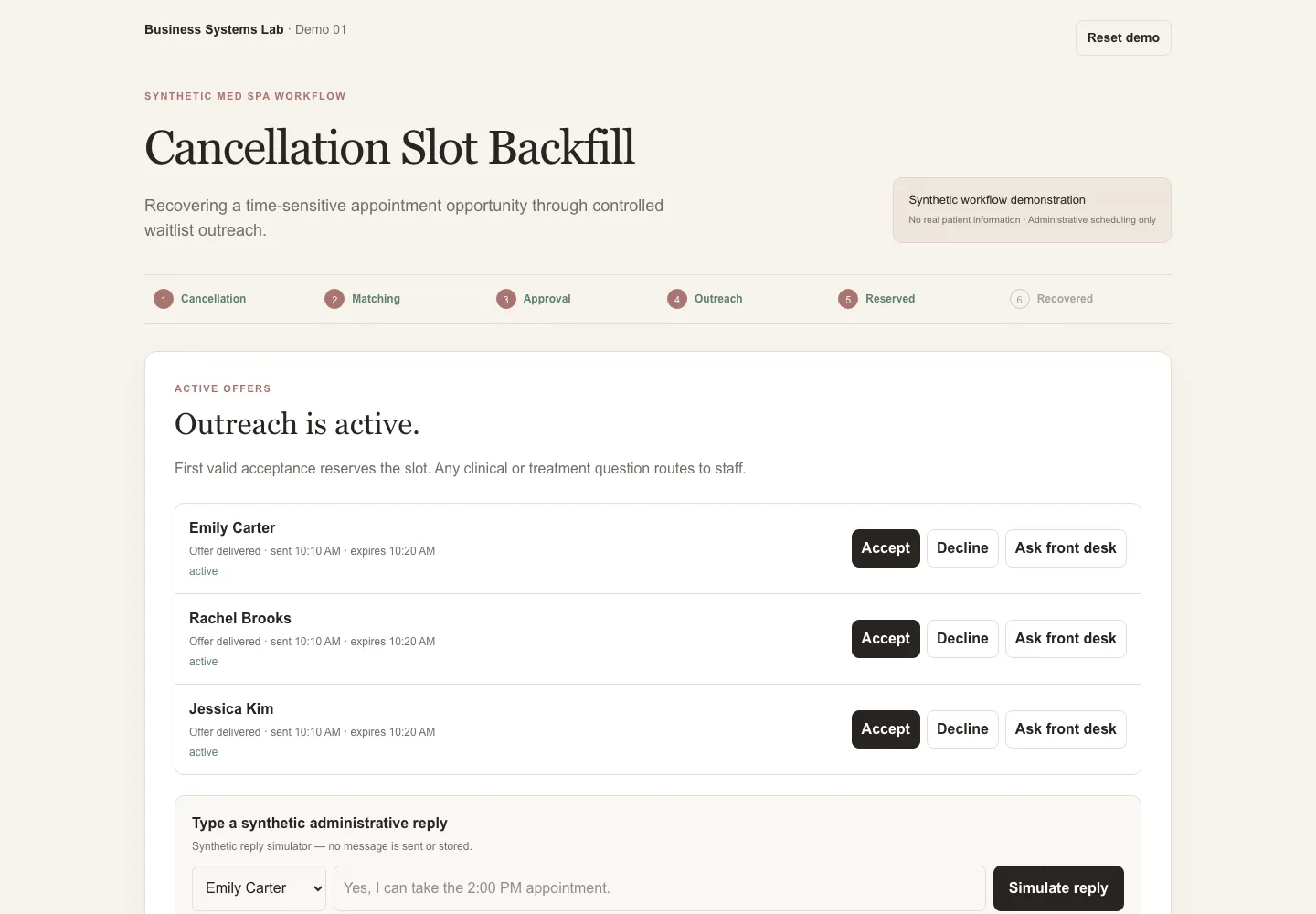
Cancellation Slot Backfill
A same-day cancellation opens a provider’s chair for a few hours, and the person expected to refill it is also running the front desk.
Open Live Demo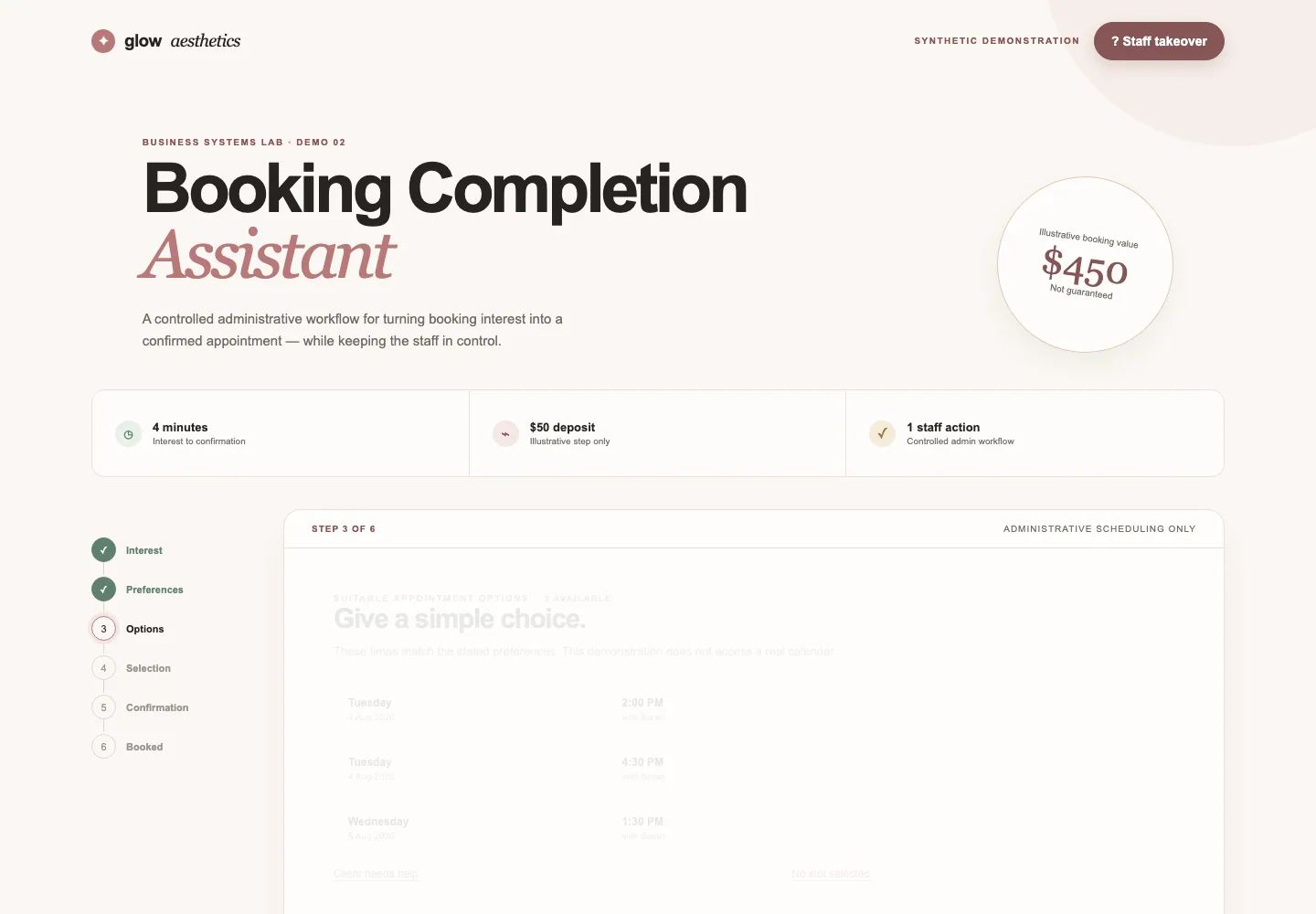
Booking Completion Assistant
Someone starts a booking, gets as far as choosing a treatment, and never finishes — the interest is recorded nowhere anyone looks.
Open Live Demo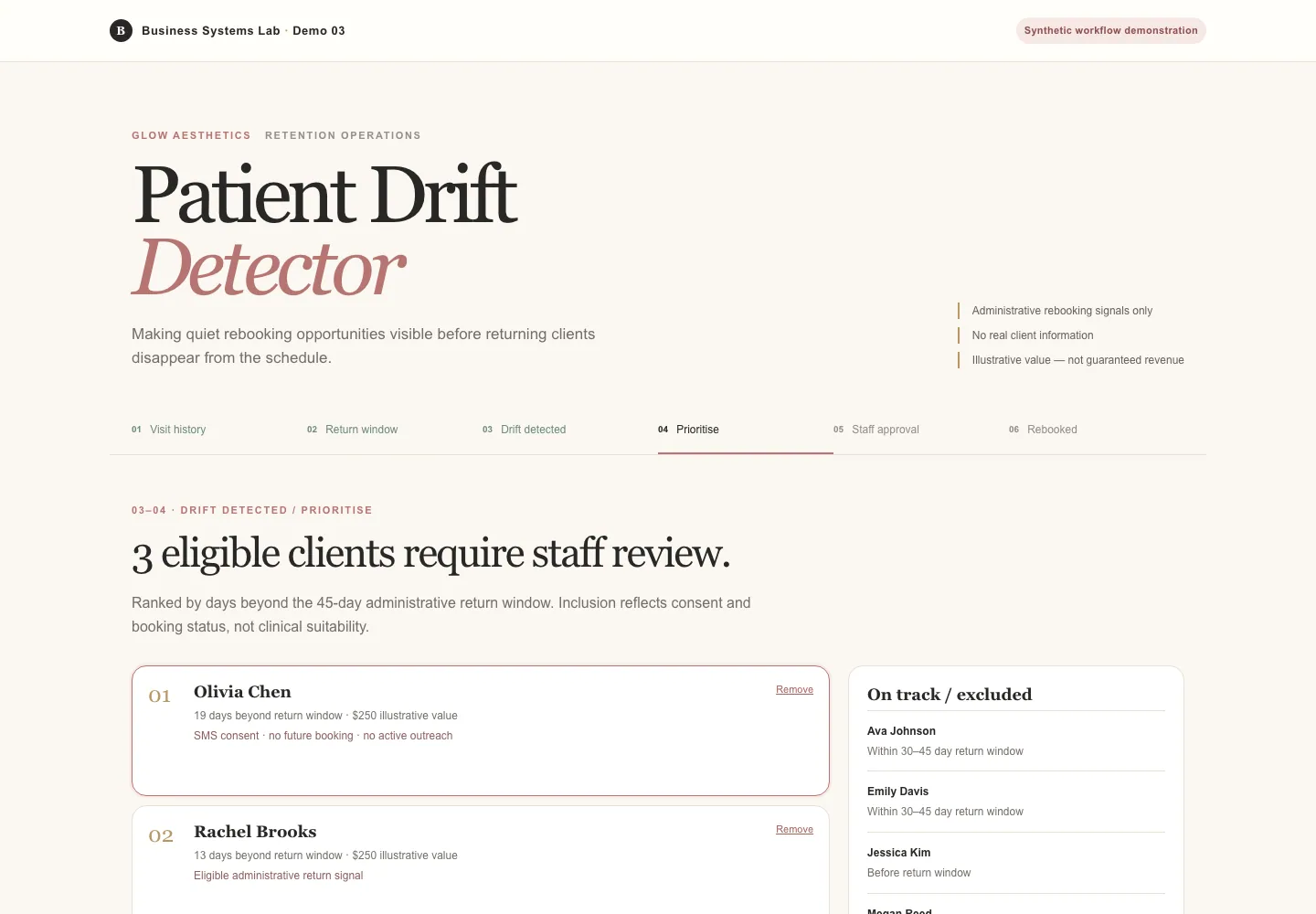
Patient Drift Detector
A patient on a regular treatment interval quietly stops returning, and nobody notices until the pattern is months old.
Open Live DemoHave a workflow worth making dependable?
Show us what happens today. We’ll help you decide whether a focused system is worth building.